The annex to the National Museum is a unique example of an engineering solution, built with sustainability in mind
Built to be low carbon and sustainable
Building technical solutions play a key role in the building since environmental management ensures the indoor conditions required for the invaluable objects in the museum.
The jointly developed solution in the construction project consists of a hybrid system of an exhaust air heat pump and ventilation units and will help to reduce the building’s lifecycle carbon footprint by 25% compared to a conventional building. This is aligned with the goal of the project developer, Senate Properties, in newbuild projects. Using heat pumps, the solution will significantly improve ventilation and waste heat recovery efficiency. Low carbon has also been achieved through design solutions. Besides the investment cost, the lifecycle cost and impact on life cycle emissions have been assessed whenever alternative solutions are compared.
“Lifecycle-wise construction is our passion. The professionalism and versatile expertise of our own building services unit, in cooperation with the demanding client, have played a key role in implementing this unique building, where building services play a major role in minimising the environmental load of the lifecycle and thus in the lifecycle-wise outcome,” says SRV President and CEO Saku Sipola.
Compact, small construction site brings special challenges to construction
The annex to the National Museum is being built on a small plot of land in a dense urban environment very close to the residential areas and thoroughfares in the Töölö district of Helsinki. Next to the annex is the over a century-old main building of the National Museum of Finland, which is undergoing renovation.
“The annex is architecturally ambitious and, as a construction project, a unique example of an engineering solution, which is being implemented by a network of top-class professionals. The National Museum annex project also brings its own fine addition to the government’s current security-focused construction. The project is being implemented using the Senate’s key project alliance model, which we have developed for the implementation of our particularly challenging construction projects,” says Jonni Laitto, Chief Operating Officer at Senate Properties.
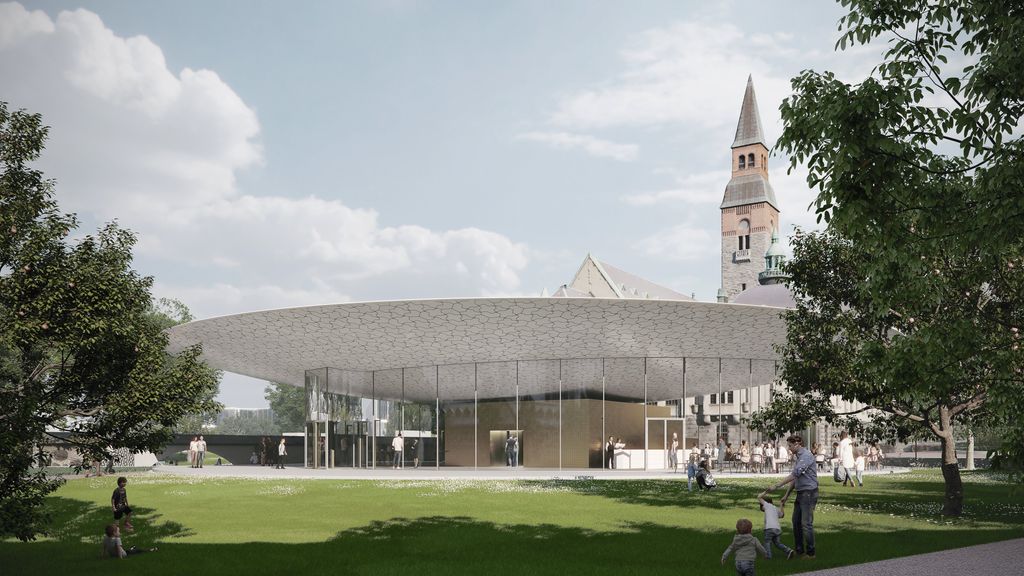
The location of the site has brought special challenges to construction. “Before actual construction work began, 20,000 cubic metres of rock were excavated from the site – while ensuring environmental safety and the preservation of historical treasures like the Gallen-Kallela frescoes in the main building. To ensure success on the compact site, one of Northern Europe’s most powerful tower cranes was also acquired for the construction site. Among other things, the crane enabled ten-tonne steel beams to be lifted over a long distance and placed directly in situ at the site. The beams forming the impressive circular roof structure were installed with particular precision on a large central pillar, and in the end, the eaves of the roof structure sank exactly 25 centimetres under the weight of the green roof, as planned,” Sipola says.
The National Museum annex has been designed by JKMM Architects. The architects office, known for its cultural landmarks, won the international architecture competition held in 2019 with its entry Atlas, based on which the extension is being built.
“Our ambition with the extension to the National Museum has been to create architecture that is both approachable and polysemic. The underside of the roof of the above-ground pavilion will be clad with over five thousand handcrafted ceramic tiles arranged in a geometric pattern, which will reflect light and provide recognition. At the same time, approximately 90% of the extension will be located underground – as exhibition, event and support spaces. Thanks to the collaboration of professionals from different fields, we have been able to combine the museum’s iconic location and meaningful architecture with functional and technical requirements – and create a museum that belongs to everyone,” says Samuli Miettinen, Founding partner and lead architect at JKMM Architects.
Annex will meet the museum’s future needs
The extension is a flexible space designed specifically for the National Museum’s exhibition activities, but also allows a wide variety of events and functions to be held.
“The long-awaited extension will serve the diverse activities and goals of the National Museum perfectly. The design has taken into account the needs of demanding activities and opportunities for development. The extension, with its appealing design language, also highlights the historical museum architectural heritage of the main building. Construction work has come at a challenging time, but the project has boldly looked far into the future and committed to high quality down to the smallest detail. The user’s views have been heard at all stages of the project. The unique building complex creates an ideal framework for implementing the mission of a national cultural institution,” says Elina Anttila, Director General at the National Museum of Finland.
The building will be around 6,000 square metres, of which around 600 square metres are above ground and the remainder underground on two levels. Around 2,500 square metres of this will be cultural spaces open to the public. The largest exhibition hall will be around 840 square metres and have a height of roughly 7 metres.
Senate Properties, which manages state-owned properties, is responsible for the construction project management and SRV for the implementation. The construction management consultant is A-insinöörit.
See the photographic material on the JKMM Architects website at https://jkmm.fi/fi/work/kansallismuseo-uusi-lisarakennus/